
Same drill, same players, a 34 °C afternoon, and suddenly the passing falls apart. Before you blame the athletes, look at what changed before the first whistle.
What It Means (in Plain Language)
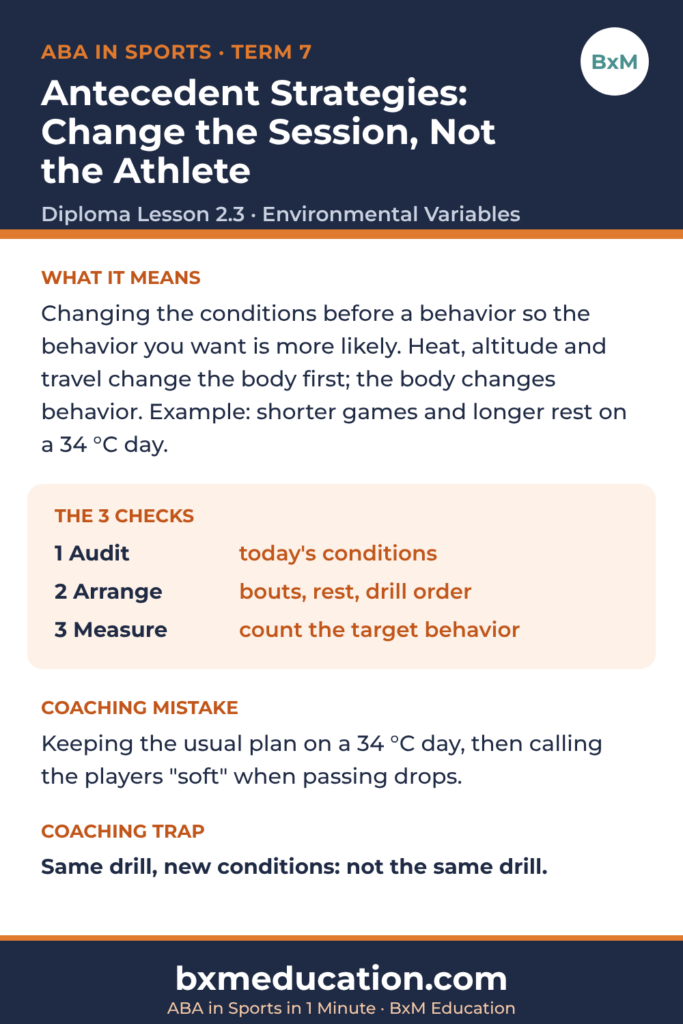
In ABA, an antecedent strategy changes the conditions that come before a behavior so the behavior you want becomes more likely. Instead of waiting for errors and reacting to them, you arrange the setting, the signals and the motivating conditions first.
Lesson 2.3 of the BxM diploma puts it in one chain: external environment → biological strain → observable athletic behavior. Heat, humidity, altitude, surface and travel don’t change behavior by magic; they change the body first, and the body changes what the athlete can do.
- Antecedent: the conditions present before and during the session: temperature, bout length, rest, the order of drills.
- Behavior: what you can see and count: completed passes, decision speed, communication, technique.
When conditions change, the same workout is no longer the same workout. So the coach changes the session, not only the athlete.
The 3 Checks
Before the session starts, run three checks:
- Audit: what conditions are present today? Temperature and humidity, altitude, surface, travel.
- Arrange: change the antecedents that matter: shorter bouts, longer rest, more water breaks, the hardest decision drill early.
- Measure: count the target behavior during the session to see whether the changes protected it.
Three yeses → you’re coaching the environment, not guessing about the athlete.
Application: Done Right
Priya, 29, plays midfield for a women’s club field hockey team. Coach Elena runs a weekly small-sided game session: 6 games of 4 minutes with 2 minutes of rest. The target behavior is completed passes under pressure (a pass that reaches a teammate while a defender is within 2 meters).
Two weeks ago, on a hot day, Elena ran the session unchanged. Priya completed 16 of 20 passes under pressure in the first half of the session and only 9 of 20 in the second half.
Today the forecast says 34 °C with high humidity. Elena audits the conditions before practice and arranges the session differently: games of 3 minutes, 3 minutes of rest in the shade with water, and the hardest decision drill moved to the first 20 minutes. She measures the same behavior: Priya completes 15 of 20 passes under pressure in the first half and 14 of 20 in the second half.
Why it works: Elena audited the environment before choosing the session, arranged the antecedents (bout length, rest, drill order), and measured the passing behavior to check that the change protected it.
Misapplication: Spot the Coaching Mistake
Same club, men’s team, same 34 °C afternoon. Coach Tom runs the usual plan: 6 games of 4 minutes, 2 minutes of rest. In the second half, completed passes under pressure drop from 15 of 20 to 8 of 20, decisions slow down and the players stop talking. Tom calls them “soft” and adds extra sprints at the end.
Spot the mistake: Tom treated a change in the environment as a problem inside the athletes. He skipped the audit, kept the antecedents the same, and then reached for punishment.
The fix: audit the conditions before practice, arrange the session for the day (bout length, rest, drill order, water breaks), and measure the target behavior. If behavior still drops, change the session again, not the label on the athlete.
How It Shows Up in Practice and on Exams
- Coaching trap: “They didn’t want it today.” Slower decisions and less communication on a hot day are behavior telling you the conditions changed. Read the data before you read minds.
- BCBA/RBT exam angle: antecedent interventions change what happens before the behavior: motivating operations and discriminative stimuli (Study Guide G.5). The “Signal” trap: adding more instructions or louder cues won’t fix behavior when the conditions behind it haven’t changed.
- Extra tip: write the audit down (temperature, surface, travel) next to your session data. Over a season, the notes show which conditions change your athletes’ behavior most.
Go Deeper
This is Lesson 2.3 of the BxM Professional Diploma in Behavioral Sport Training. The full lesson covers environmental adaptation vs. exercise adaptation, the behavioral warning signs of environmental overload, and the complete pre-session environmental audit.
Keep Studying
- Term 6 of this series: Socially Significant Behavior in Sports Explained
- Term 3 of this series: Stimulus Control in Sports Explained
- ABA glossary: Antecedent Intervention
- Watch every sports term: ABA in Sports in 1 Minute playlist
Quick Check (2 Questions)
Question 1. An adult soccer coach sees that on 33 °C days her players’ passing accuracy drops late in practice. Which response is an antecedent strategy?
A) Adding extra laps at the end for every missed pass
B) Telling the players they need more mental toughness
C) Shortening the drills and lengthening the rest periods before the next hot session
D) Praising the players who complete the most passes after practice
Show answer
C. It changes the conditions before and during the behavior (bout length and rest), which is what an antecedent strategy does. A is a consequence, and a punishment procedure. B is a label, not a change to the environment. D is a consequence (reinforcement after the behavior), not an antecedent change.
Question 2. In the BxM diploma’s chain, how does extreme heat affect an athlete’s decisions on the field?
A) Heat changes behavior directly, with no biological step
B) Heat only affects athletes who lack motivation
C) Heat has no effect if the workout is the same
D) Heat raises biological strain, and that strain changes observable behavior
Show answer
D. The lesson’s model is external environment → biological strain → observable behavior. A skips the biological step. B turns an environmental effect into a personality label. C ignores that the same prescription produces different strain and behavior under different conditions.
Reference
BxM Education & Consulting. (2026). Professional Diploma in Behavioral Sport Training, Lesson 2.3: Environmental variables and athletic performance. BxM Education.
BxM Education. (2024). BxM Education BCBA 6th Edition Study Guide (Domain G, G.5). BxM Education.
Cooper, J. O., Heron, T. E., & Heward, W. L. (2020). Applied behavior analysis (3rd ed.). Pearson.