
You talk one way to your clinical director and another way to your best friend. Skinner’s analysis of verbal behavior has a term for the person who makes that difference: the audience. Domain B (Concepts & Principles) items test whether you can see the audience as an antecedent, not just “the person in the room.”
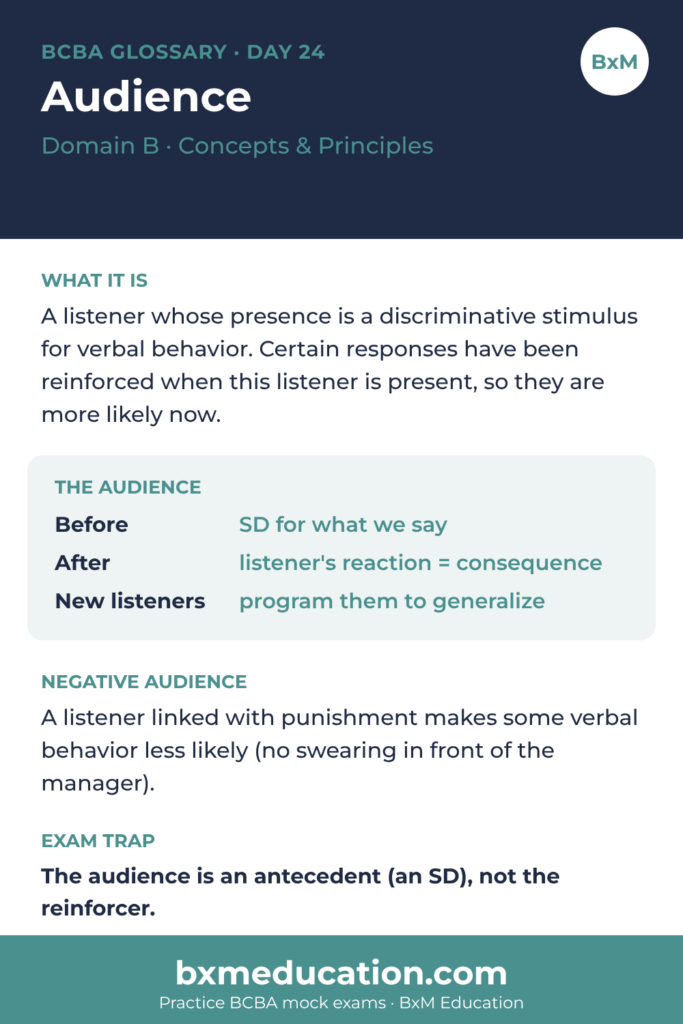
Cooper, Heron, and Heward (2020) describe the audience as a listener (or a group of listeners) whose presence functions as a discriminative stimulus for verbal behavior. Certain responses have been reinforced in the presence of that listener in the past, so the speaker is more likely to emit those responses when that listener is present, and less likely to emit others.
This builds on the idea of an antecedent stimulus class: many different people can share the same function as an audience for a given repertoire. It also connects to arbitrary relations, since much of what an audience reinforces is learned through a verbal community, not physical features. And it follows the previous term, ascending baseline.
The Mechanics: The Audience Is an SD, Not a Consequence
- Antecedent, not consequence. The audience is present before the verbal response and signals that certain verbal behavior is likely to be reinforced. The listener’s reaction afterward is the consequence.
- History decides the function. A listener becomes an audience for a repertoire because that repertoire has been reinforced in their presence (and not reinforced, or punished, in the presence of others).
- Audiences differ. The same speaker uses technical terms with a supervisor, plain language with a family member, and a second language with a coworker who speaks it. Each listener evokes a different repertoire.
- Negative audience. A listener whose presence has been paired with punishment of certain verbal behavior makes that behavior less likely (for example, not swearing in front of a manager).
- The speaker can be their own audience. In self-talk and private verbal behavior, the speaker also functions as a listener.
Clinical Applications
- Generalization of language programs. An adult client manding only with the therapist shows the therapist has become the audience. Plan for multiple audiences (job coach, family, coworkers) so the repertoire is not limited to one listener.
- Staff training. A new technician explains a procedure clearly to the BCBA but freezes with caregivers. Practice with different audiences during behavioral skills training.
- Assessment notes. When verbal behavior varies across settings, record who was present. The audience may explain the variability better than the setting.
- Ethics and communication. Adjust the level of technical language to the audience when you report to families and other professionals; same content, different repertoire.
Research Consulting & APA Citation Reference
Clinical & Methodological Recommendation: When a client’s verbal behavior shows up with one person but not another, analyze the listener as an antecedent. Identify which audiences have reinforced the response, then program reinforcement across a range of new listeners so the repertoire generalizes beyond a single audience.
APA Reference Citation (7th Edition):
Cooper, J. O., Heron, T. E., & Heward, W. L. (2020). Applied behavior analysis (3rd ed.). Pearson.
Advanced Applied Reasoning Quiz
Question 1
An adult client at a supported-employment site asks for help with full sentences when his job coach is nearby, but says nothing when other coworkers are present. Which statement best describes the job coach’s role?
A) The job coach is a consequence that punishes requests
B) The job coach functions as an audience, a discriminative stimulus for requesting
C) The job coach is a motivating operation that increases the value of help
D) The job coach is an unconditioned reinforcer
Question 2
A BCBA notices that a supervisee uses precise behavioral terms in supervision meetings but switches to plain language when talking with a client’s family. What is the best explanation?
A) Different listeners function as different audiences, each evoking a different verbal repertoire
B) The supervisee’s technical vocabulary is undergoing extinction
C) The family is providing a negative reinforcement contingency for jargon
D) The supervisee is showing stimulus overselectivity
Check Your Answers
Replay the video above to review the logic behind each scenario, then test yourself under exam conditions in the BCBA Mock Exam System. Previous term: ascending baseline. Next term: autoclitic.