
Test your clinical discrimination skills with these three exam-style questions built specifically around the heavy-hitting domains of the 6th Edition Test Content Outline.
Day 13 covered the ratio schedules, where reinforcement depends on a count of responses. Day 14 moves to the interval schedules, where reinforcement depends on time passing and then one response:
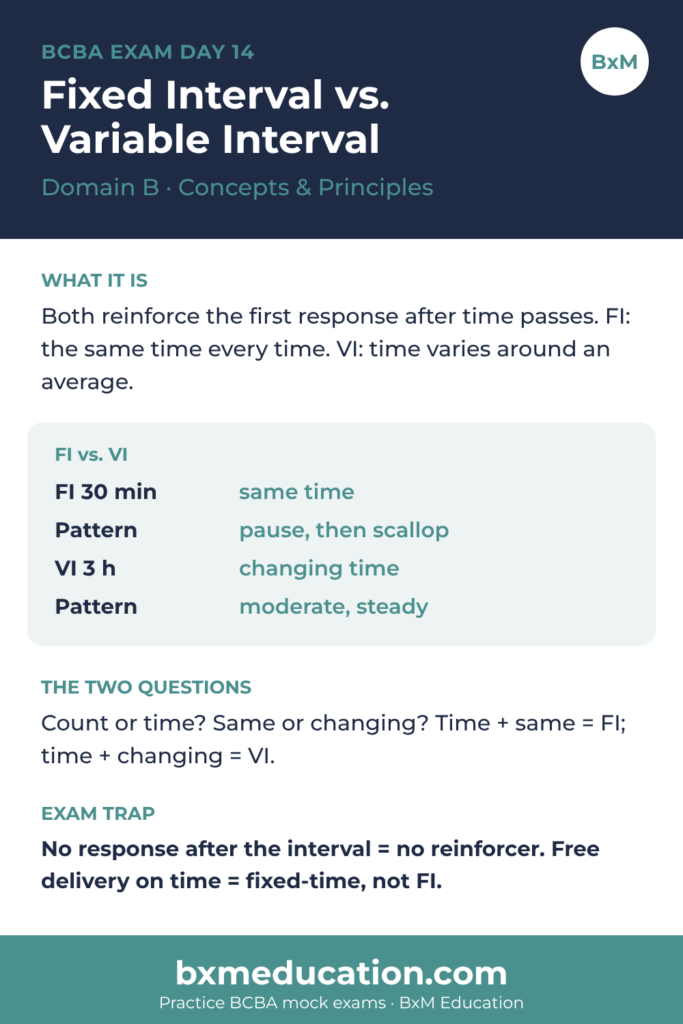
- Fixed interval (FI): reinforcement is delivered for the first response after a set, unchanging amount of time has passed since the last reinforcer (FI 10 min). Responses during the interval do nothing. Typical pattern: a pause after reinforcement, then responding that speeds up as the end of the interval gets closer, the FI scallop.
- Variable interval (VI): reinforcement is delivered for the first response after an amount of time that changes from one reinforcer to the next around an average (VI 10 min). Typical pattern: a moderate, steady rate with few pauses, because a reinforcer could become available at any moment.
The test is two questions: Is it a count of responses (ratio) or time and then a response (interval)? Then: Is the time the same every time (fixed) or does it vary around an average (variable)? One more trap: in an interval schedule the reinforcer is not delivered just because time passed; the learner still has to respond after the interval ends.
Question 1 (Domain B: Schedules of reinforcement)
In a group home, an adult resident checks the mailbox for a delivery that arrives on an unpredictable schedule, sometimes after 1 hour, sometimes after 5 hours, averaging 3 hours. The first check after the delivery arrives is reinforced. Which schedule is this?
A) Fixed interval 3 hours (FI 3 h)
B) Variable ratio 3 (VR 3)
C) Variable interval 3 hours (VI 3 h)
D) Fixed-time 3 hours (FT 3 h)
Question 2 (Domain B: Schedules of reinforcement)
An adult employee can collect a bonus voucher at the front desk for the first request made after each 30-minute period has passed. Data show almost no requests early in each period and more and more requests as the 30 minutes run out. What does this pattern show?
A) The fixed-interval scallop
B) The postreinforcement pause and run of a fixed-ratio schedule
C) Steady responding typical of a variable-interval schedule
D) Ratio strain
Question 3 (Domain B: Schedules of reinforcement)
A behavior analyst wants an adult client’s on-task checking of a work list to occur at a moderate, steady rate with few pauses, and reinforcement should depend on the passage of time rather than the number of checks. Which schedule best fits?
A) Fixed ratio 10 (FR 10)
B) Variable interval 5 minutes (VI 5 min)
C) Fixed interval 5 minutes (FI 5 min)
D) Continuous reinforcement (CRF)
Written Answer Explained
Question 1 Breakdown (Domain B: Schedules of reinforcement)
Core Scenario Summary: The first mailbox check after an unpredictable delay (averaging 3 hours) is reinforced.
Correct Answer: C) Variable interval 3 hours (VI 3 h)
Clinical Analysis & Distractor Rationales:
- Why A is Incorrect: FI 3 h would make the reinforcer available after the same 3 hours every time. Here the time varies.
- Why B is Incorrect: VR 3 depends on the number of responses. Checking more often doesn’t bring the delivery sooner; time does.
- Why C is Correct: Reinforcement becomes available after a varying amount of time around an average of 3 hours, and the first response after that is reinforced: VI 3 h.
- Why D is Incorrect: A fixed-time schedule delivers the stimulus after a set time with no response required. Here the resident has to check the mailbox, and the time isn’t fixed.
Question 2 Breakdown (Domain B: Schedules of reinforcement)
Core Scenario Summary: Few requests early in each 30-minute period, accelerating toward the end.
Correct Answer: A) The fixed-interval scallop
Clinical Analysis & Distractor Rationales:
- Why A is Correct: On an FI schedule, responding is low right after reinforcement and speeds up as the end of the interval approaches, producing the scalloped cumulative record.
- Why B is Incorrect: Fixed-ratio schedules also show a pause after reinforcement, but then a high, steady run of responding, not a gradual acceleration. And this schedule is time-based, not count-based.
- Why C is Incorrect: Variable-interval schedules produce moderate, steady responding without the acceleration shown here.
- Why D is Incorrect: Ratio strain is the breakdown of responding when a ratio requirement is raised too quickly. There is no ratio here.
Question 3 Breakdown (Domain B: Schedules of reinforcement)
Core Scenario Summary: Goal is moderate, steady responding with reinforcement tied to time.
Correct Answer: B) Variable interval 5 minutes (VI 5 min)
Clinical Analysis & Distractor Rationales:
- Why A is Incorrect: FR 10 ties reinforcement to the number of checks, not time, and produces high rates with pauses after reinforcement.
- Why B is Correct: VI schedules tie reinforcement to time and typically produce moderate, steady responding with few pauses.
- Why C is Incorrect: FI 5 min ties reinforcement to time, but it typically produces the scallop (pausing after reinforcement), not steady responding.
- Why D is Incorrect: CRF reinforces every response; it is useful for building a new behavior, not for steady time-based responding.
Keep studying: Review Exam Day 13: fixed ratio vs. variable ratio and Exam Day 12: continuous vs. intermittent reinforcement, then test yourself on the full item bank in the BxM Mock Exam System.