
Test your clinical discrimination skills with these three exam-style questions built specifically around the heavy-hitting domains of the 6th Edition Test Content Outline.
Day 7 closes the first week of the 365-day curriculum with the contrast that sits under everything else in Domain A:
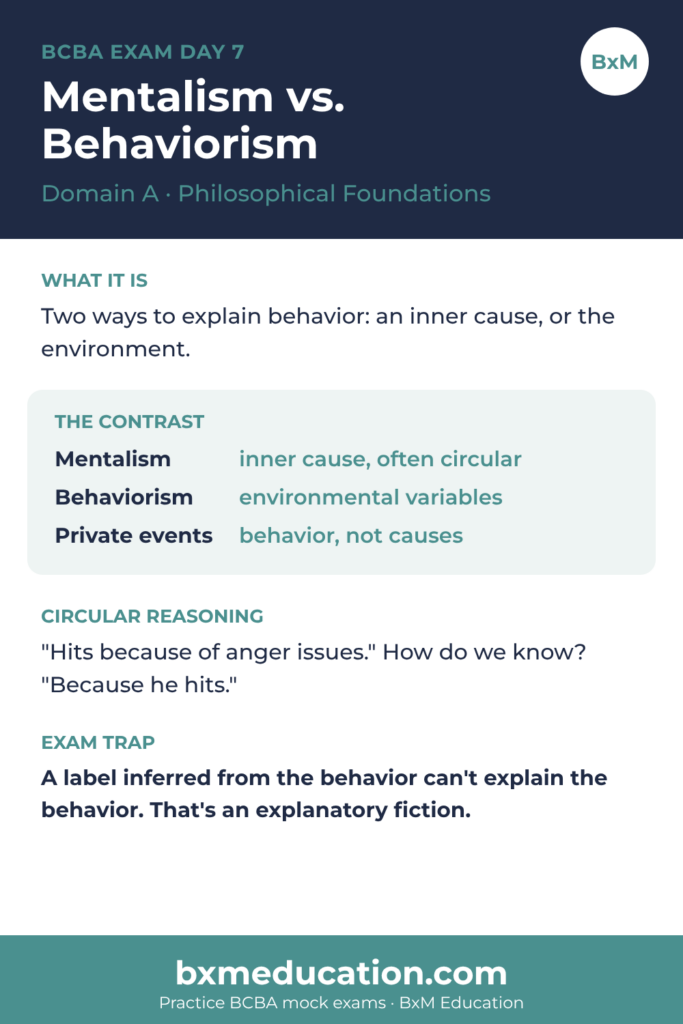
- Mentalism: an approach to explaining behavior that assumes an inner, mental dimension, separate from behavior, whose events directly cause or mediate behavior. Mentalistic explanations rely on hypothetical constructs (anger issues, low motivation, willpower) that are inferred from the very behavior they are meant to explain.
- Behaviorism (radical behaviorism): the philosophy of the science of behavior. It explains behavior through its relations with environmental variables (antecedents, consequences, and learning history) and treats thoughts and feelings as private events: behavior to be explained, not inner causes.
The giveaway is circular reasoning. “He hits because of anger issues.” How do we know he has anger issues? “Because he hits.” A label that comes only from the behavior, then is offered as its cause, is an explanatory fiction, and it gives you nothing to change.
Question 1 (Domain A: Mentalism vs. behaviorism)
A staff note says an adult client in a group home “hits staff because of his anger issues.” When the BCBA asks how staff know he has anger issues, the answer is, “Because he keeps hitting people.” Which best describes the staff’s explanation?
A) Radical behaviorism
B) Functional analysis
C) Determinism
D) Mentalism, using an explanatory fiction
Question 2 (Domain A: Mentalism vs. behaviorism)
The BCBA rewrites the note: “Hitting occurs most often when a chore is presented, and it is usually followed by staff removing the chore.” Which approach does the rewritten explanation reflect?
A) Mentalism
B) Behaviorism
C) Structuralism
D) A hypothetical construct
Question 3 (Domain A: Mentalism vs. behaviorism)
An adult client tells his BCBA, “I feel anxious before every team meeting,” and then often calls in sick on meeting days. How would a radical behaviorist treat the client’s report of feeling anxious?
A) As the mental cause of the absences
B) As unscientific because it cannot be observed by others, so it is left out of the analysis
C) As behavior (a private event) that is itself related to environmental variables
D) As proof that an inner mental dimension controls behavior
Written Answer Explained
Question 1 Breakdown (Domain A: Mentalism vs. behaviorism)
Core Scenario Summary: A label (“anger issues”) is inferred from the hitting and then offered as the cause of the hitting.
Correct Answer: D) Mentalism, using an explanatory fiction
Clinical Analysis & Distractor Rationales:
- Why A is Incorrect: Radical behaviorism explains behavior through environmental variables and rejects inner causes like “anger issues.”
- Why B is Incorrect: A functional analysis manipulates environmental conditions to identify what maintains behavior. Nothing was tested here.
- Why C is Incorrect: Determinism is the assumption that behavior is lawful and has causes. The staff do assume a cause, but the problem is the kind of cause: an inner one inferred from the behavior.
- Why D is Correct: Mentalism explains behavior with an inner dimension. “Anger issues” is a hypothetical construct inferred from the hitting and then used to explain it, which is circular reasoning, an explanatory fiction.
Question 2 Breakdown (Domain A: Mentalism vs. behaviorism)
Core Scenario Summary: The explanation now names an antecedent (chore presented) and a consequence (chore removed).
Correct Answer: B) Behaviorism
Clinical Analysis & Distractor Rationales:
- Why A is Incorrect: Mentalism points to inner causes. The rewrite names only observable environmental events.
- Why B is Correct: Behaviorism explains behavior through its relations with the environment. Naming the antecedent and the consequence (escape from the chore) is a behavioral account, and it suggests what to change.
- Why C is Incorrect: Structuralism describes the form of behavior (what it looks like) without analyzing its function. The rewrite is about when hitting happens and what follows it, which is function.
- Why D is Incorrect: A hypothetical construct is an inferred, unobserved entity. Chores and their removal are directly observable events.
Question 3 Breakdown (Domain A: Mentalism vs. behaviorism)
Core Scenario Summary: The client reports a feeling; the question is how radical behaviorism handles private events.
Correct Answer: C) As behavior (a private event) that is itself related to environmental variables
Clinical Analysis & Distractor Rationales:
- Why A is Incorrect: Treating the feeling as the cause of the absences is a mentalistic explanation. Radical behaviorism looks for the environmental variables behind both the feeling and the absences.
- Why B is Incorrect: Leaving out events that only the person can observe is the position of methodological behaviorism. Radical behaviorism includes private events.
- Why C is Correct: Radical behaviorism treats thoughts and feelings as private events, behavior that follows the same principles as public behavior and is explained by the environment and learning history.
- Why D is Incorrect: Radical behaviorism does not accept a separate mental dimension. Private events are behavior, not evidence of an inner controller.
Keep studying: review Exam Day 2: radical vs. methodological behaviorism, go back to Exam Day 6: experimentation vs. replication vs. philosophic doubt, and see how anecdotal observation helps replace labels with environmental events. Then test yourself under exam conditions in the BCBA Mock Exam System.
APA Reference Citation (7th Edition):
Cooper, J. O., Heron, T. E., & Heward, W. L. (2020). Applied behavior analysis (3rd ed.). Pearson.