
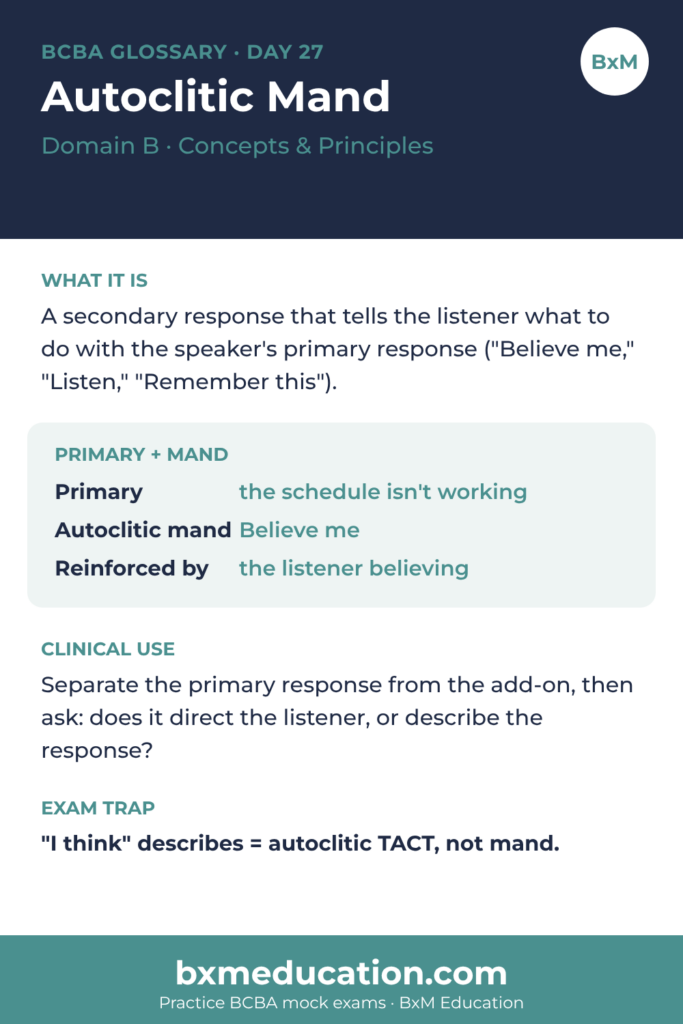
A job coach tells her supervisor, “Believe me, the new schedule isn’t working.” The main message is “the new schedule isn’t working.” But what is “believe me” doing? It doesn’t describe the schedule. It tells the listener what to do with the message. That small add-on is an autoclitic mand, and Domain B (Concepts & Principles) items test whether you can tell it apart from a plain mand and from an autoclitic tact.
Cooper, Heron, and Heward (2020) describe the autoclitic mand as verbal behavior under the extra control of a motivating operation related to some part of the speaker’s main (primary) verbal response. The autoclitic piece asks the listener to take a specific action regarding that primary response, and the speaker’s autoclitic behavior is reinforced when the listener does it. In plain terms: the speaker says something, and the autoclitic mand tells the listener how to treat it: believe it, listen to it, remember it, ignore it.
This follows the previous term, autoclitic frame, and the parent term autoclitic: an autoclitic is a secondary verbal response that depends on, and modifies the effect of, a primary operant.
The Mechanics: Primary Response + “Do This With It”
- Two layers. The primary response carries the content (“they are wrong”). The autoclitic mand (“believe me”) rides on it.
- Controlled by an MO. Like any mand, it is under the control of a motivating operation, here one related to how the listener will treat the primary response (the speaker “wants” to be believed, heard or remembered).
- Specifies listener action. It enjoins the listener to do something about the primary response: “Listen,” “Remember this,” “Don’t repeat this,” “Note that…”
- Reinforced by that action. The autoclitic behavior pays off when the listener believes, attends to or acts on the message.
- Not an autoclitic tact. An autoclitic tact (“I think,” “I saw”) tells the listener something about the primary response or its controlling variables (how sure the speaker is, where the information came from). An autoclitic mand tells the listener what to do.
Clinical Applications
- Advanced verbal repertoires. Adults with strong mands and tacts can be taught to add autoclitic mands that shape how others respond to them: “Please listen, this is important,” “Remember, my shift ends at 3.”
- Self-advocacy at work. An adult employee who says “Write this down: I need Friday mornings off for medical appointments” is more likely to be accommodated than one who states the need once and moves on.
- Analyzing staff language. In supervision, “Trust me, the plan is working” is an autoclitic mand. It asks the listener to believe the speaker, so a supervisor should respond to the data, not the autoclitic.
- Programming. Teach autoclitic mands with several primary responses and listeners, so “Please listen” is not tied to one sentence or one person.
Research Consulting & APA Citation Reference
Clinical & Methodological Recommendation: When analyzing a learner’s or a staff member’s verbal behavior, first separate the primary response from any autoclitic. Then ask one question: does the autoclitic tell the listener something about the response (autoclitic tact) or tell the listener what to do with it (autoclitic mand)?
APA Reference Citation (7th Edition):
Cooper, J. O., Heron, T. E., & Heward, W. L. (2020). Applied behavior analysis (3rd ed.). Pearson.
Advanced Applied Reasoning Quiz
Question 1
A day-program staff member tells a nurse, “Please listen carefully: Mr. Alvarez skipped lunch today.” Which part of the statement is an autoclitic mand?
A) “Mr. Alvarez skipped lunch today,” because it is controlled by the nonverbal event
B) The whole statement, because the speaker wants lunch for the client
C) “Please listen carefully,” because it tells the listener what to do with the primary response
D) “Please listen carefully,” because it tells the listener how certain the speaker is
Question 2
Which example is an autoclitic tact rather than an autoclitic mand?
A) “Believe me, the shipment is late.”
B) “Remember this: the code is 4417.”
C) “Don’t tell anyone, but I’m applying for the lead job.”
D) “I think the shipment is late.”
Check Your Answers
Watch the video above for the answer to each question and the reasoning behind it, then test yourself under exam conditions in the BCBA Mock Exam System. Previous term: autoclitic frame. Next term: autoclitic tact.